
‘Breaking Fast, breaking bread’

Good morning,
In the very first Companionship email, on 15 March, I explored why Companionship seemed a good name for these communications. I wrote: the etymology of companion may also be helpful. Literally it means “one who breaks bread with another”. Christians do this in communion, and many faiths include shared meals as significant parts of their common life. And indeed, eating alone can be one of the hardest things about isolation.
Since then I’ve heard of friends who have had a remarkable dinner party, eating at the same time while on a video-call, starter, main and pudding. And Muslims, who often meet during Ramadan after sunset to eat together in Mansefield, the Chaplaincy building, have not been able to do so. They have broken their fast each night with others in their household. Tonight (or tomorrow night) marks the end of Ramadan with Eid-al-Fitr, the Festival of Breaking the Fast, with prayers and celebrations.
Regarding communion, different churches around the world and in Scotland have taken different approaches to whether sacraments can be celebrated online. Those churches which have said it is not possible to receive communion in a different space from others, have encouraged the practice of spiritual communion, the means of grace by which a person, prevented for some serious reason from sharing in a celebration of the Eucharist, nonetheless shares in the communion of Jesus Christ.
The Church of Scotland, of which I am a minister, asked its Theological Forum to consider the practice of online communion. It so happens that I am the Convener of the Theological Forum (until next May), and so had the opportunity to think through these questions. The Theological Forum’s reflections can be found in full here: https://www.churchofscotland.org.uk/about-us/councils-committees-and-departments/committees/theological-forum/reflections-on-online-communion
For people who are really fascinated (perhaps it’s only me), two former preachers in St Salvator’s Chapel have written rather different reflections on the questions. Here is Revd Prof Donald Macleod, of the Free Church of Scotland: https://www.donaldmacleod.org.uk/dm/online-communion-services/
And here is Revd Dr Steve Holmes, of our own St Mary’s College, and a Baptist. (This comes in two parts.)
http://steverholmes.org.uk/blog/?p=7716
http://steverholmes.org.uk/blog/?p=7721
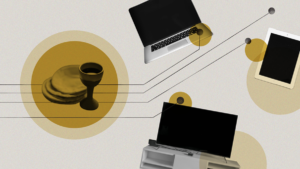
The heart of my view, drawn from the Forum’s reflections, follows. This is why I am looking forward to breaking bread with others tomorrow, for Ascension, at the end of the chaplaincy service online.
Online worship generally, and online Communion in particular, has provided a profoundly moving experience of community for people. Under the current restrictions of physical distancing (often called social distancing) and self-isolation, a large proportion of the population is spending the day indoors, able only to be with those who share their household. For people who live alone (but not only them), the possibility of isolation is obvious. Online worship by means of video-conferencing (eg Zoom) has provided a strong sense of community, with people able to see and hear their fellow church members and others in real time, worshipping and praying together. Others have watched recorded or partially or fully live services produced by their own churches and streamed (eg on YouTube or Facebook).
Part of the meaning of the sacrament of the Lord’s Supper is the uniting of the body of Christ in the shared meal. Online communion brings to the fore in a significant way that meaning of the sacrament.
It also makes clear the spiritual presence of Christ. We celebrate communion in the time of the ascended Christ. We do not share a meal with the physical Jesus as did the disciples. Instead, we share in his real presence made spiritually present for us by the Holy Spirit. In our own homes, and separated physically from our sisters and brothers, we may experience the presence of Christ no less than when in church. Indeed, some may experience that presence in a particularly vivid way online.
It is at least arguable that the essence of Holy Communion – the ongoing reception of the forgiving grace of God in the physical and nourishing signs of Christ’s body and blood – is even more important in a time when other ways in which we apprehend God’s love may be limited, such as work, meeting friends and family, acts of discipleship and church fellowship.
There are reasons why some will hesitate before adopting online celebrations of Holy Communion. For some the single physical location of the congregation is essential, conveying the theological insight that God took human flesh in one single physical human being. A dispersed congregation is arguably not a congregation at all.
And yet the experience of people worshipping together is often quite otherwise, that the bonds of unity seem all the stronger in an online service when physically prevented from being together in church.
And it has been argued that this time is so difficult, so far from God’s kingdom-community, that we should refrain from online communion, which seems almost to hallow our being separated. Certainly this argument has a certain force against online worship being normative. But at this time, we are considering an abnormal situation, worship and sacraments in extremis. We can still lament the coronavirus, and the suffering it is bringing across the world directly and indirectly, while gathering in spite of it, as a community which prays for justice and peace to come, which eats and drinks together in anticipation of the heavenly banquet, and which trusts in God’s love which reaches out to creation in infinitely creative ways.
So much for argument. Tomorrow we hold our final Sunday service of the Candlemas Semester and academic year at 11 am (British Summer Time). Sam will lead prayers, the choir will sing music by Charles Villiers Stanford, and I will preach. At the end, people will be welcome to stay online for a short service of communion. People are welcome to stay online or not, and choose to receive or not. As I am a Church of Scotland minister and we practise an open table, all Christians are welcome to receive.
Yours,
Donald.