
Advent Calendar – 18 December

Nativity Stories: Magi
Our bread and butter, you could say, is charts. The people come and put a coin or two into our hands and expect a chart. Will this woman make a good wife? When would be propitious for the wedding day? Will this be the right premises for trading pomegranates or walnuts or carpets? What will this child’s fortune be? Will I get better from this illness? And we ask some questions in return – Where born and when? What exact location? What day do you intend? – and we consult the volumes on our shelves, the movement of the spheres, the position of the stars, the trajectory of the constellations, the phases of the moon. From all this knowledge, and perhaps a little intuition, we make a chart and say, Yes, yes, this is auspicious. We recommend you proceed without delay. Or, The stars do not portend well for such a venture, at least, not now. Either way they leave with satisfaction, a certainly where there was doubt before. And we, whether our news is good or ill, receive our recompense.
Some nights when skies are clear we keep a watch. There are always movements to observe: conjunctions, brightenings, heavenly events, some predicted in the books, some unexpected. The skies have much to say to those with eyes cast upward. And so it was, when Balthazar was watching one cloudless night, and saw a star rising where it hadn’t been before. We noted the quadrant and charted its position against the date. By day, we found a single text implying that such a star at such a time augured the coming of a new king for the Hebrews, a people far west of us.
Years of looking up and reading the old wisdom, and making charts but nothing, nothing like this promise. It felt that we had studied all our lives for this. We left one magus behind, unable for the journey, to write the charts for all who came as long as we were gone. We travelled west by night, on paths we’d never taken but with the sky to guide, clearer than any so-called directions given us in Persian, Babylonian or whatever tongues they spoke. The new king’s star still rose, and went ahead of us, bright, clear, almost warm in the cold of the night-sky.
One morning as we drew the camels up at some flyblown village, enduring the usual stares of women, men and children, we asked who these people were and they said they were children of Abraham, who served the living God called Adonai. We had arrived, at last. “We’ve come,” we said, “to meet your king.”
“Him?” they shrugged. “His palace is in Jerusalem. Better there than here.”
We kept our counsel till we rode into Jerusalem, two days hence. It was a fine city of stone walls and lively streets, grand houses and fragrant gardens of cypress and juniper, of olives, dates and figs in the market. We entered the city by the eastern gate and asked the passers-by, “Where is your new king? The one just born? We’ve seen his sign, his star rising into the sky. He must be near here. We’ve travelled for weeks now and want to worship him, he whose star has led us so far from home.” But the people shrank away from us, and said, with fear in their eyes, “There’s no new king here, only Herod, not forgetting Caesar’s man Quirinius. Your journey has been wasted.”
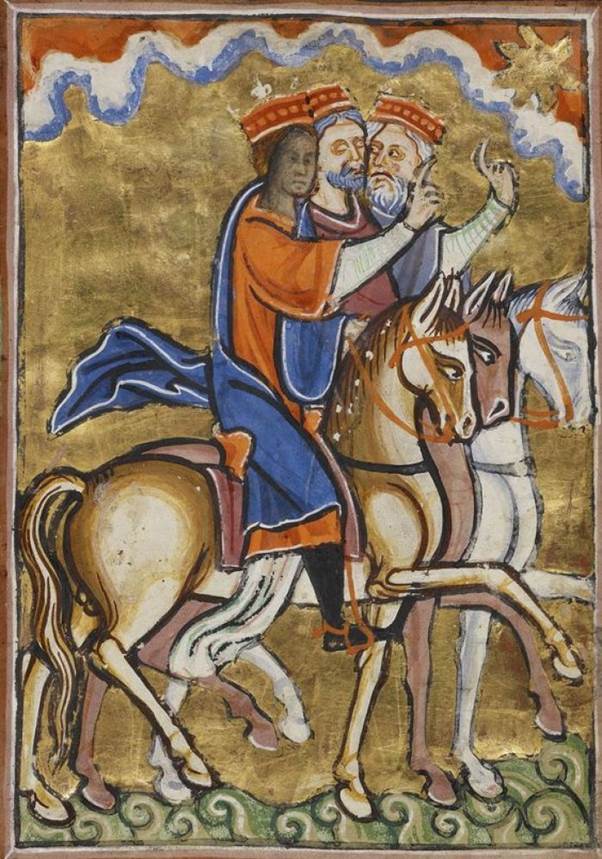
The Journey of the Magi, in Illustrated Vita Christi